My father was arrested when state security officers raided our house on Dec. 24, 2006 at dawn. Over the next couple of weeks, 33 Muslim Brotherhood leaders and members of the organization were arrested and charged with money laundering, financing and belonging to an illegal organization.
A few weeks later, on Jan. 30, a Cairo criminal court dismissed all charges and actually referred to the detainees as "respectable doctors, accountants, businessmen and professionals" and described the charges as "intentionally fabricated by state security officers, groundless and politically motivated with no substantial evidence whatsoever." The court ordered the immediate release of all detainees.
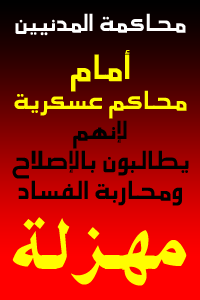
But instead they were re-arrested inside the courtroom. President Hosni Mubarak, in his capacity as military ruler, ord ered the transfer of their case to a military tribunal.
This was to proceed over 69 court sessions shrouded in secrecy, where media representatives and human rights observers were denied access to the courtroom. Only relatives 'of the first degree' and lawyers were allowed to attend these sessions, where mega scandals, theft and forgery incidents committed by state security officers were exposed. The financial committee assigned by court to investigate the case denied money laundry charges, and so they were dropped by court.
The verdict session was adjourned twice to be finally booked after municipal elections which were held on April 8 – evidence of the political nature of the trial. The third verdict session was scheduled on April 15, and knowing that that there was no political need for further adjournments, we expected the verdict to come out on that day.
Along with several members of my family we left home very early on that day, hoping to overcome expected security road blocks on the road to Haikstep military base, some 30 kilometers northeast of Cairo, where the trial was scheduled to be held. Hundreds of police officers supported by thousands of soldiers and men in plainclothes who could only be described as "thugs" were waiting for us. They had blocked the surrounding area, preventing us from parking our cars or accessing the military base.
I dropped my mother and sister at the nearest possible point to the Haikstep entrance and went to park. Police officers and "thugs" prevented me from parking, until I reached a distant spot where I was finally allowed to park. I left the car and began walking to the Haikstep military base.
Approaching the entrance I saw my mother quarrelling with a police officer who was blocking the way to the courtroom. When my mother insisted that it was her right as part of the immediate family to be allowed in, he replied by insulting her. My brother Ahmed attempted to intervene, only to be set upon by a group of no less than 10 thugs and soldiers who beat and kicked him with their legs and batons. My other brother Hamza and Uncle Mahmoud tried to pull Ahmed away from the soldiers, but they were trapped themselves, and all three were harshly beaten and then taken into custody.
When I saw thugs beating Ahmed, I rushed toward them, hoping to keep my mother away from violence. I was stopped by a thug who ordered me to standstill. When I refused, he grabbed my arm and twisted it behind my back. He held my head with his other hand and to my horror, began knocking it against the window of a parked car.
I was shocked, and could not believe that I was being beaten. Beating women in the streets goes against every Egyptian norm, even those of the dictatorial brutal regime. Though there have been incidents of women being harassed (sometimes sexually abused) in demonstrations in Cairo, I never imagined that I would be in such a situation.
It took a few seconds for the reality of what was going on to sink in: my head was being repeatedly knocked against a car window, and started to feel dizzy. I began screaming, hoping to attract attention and that someone would intervene and save me. Police officers, soldiers and thugs were all over the place, and they seemed to be enjoying the scene. None attempted to stop the assault.
I then found myself on the ground, dragged by this thug (who was calling me names, and insulting my entire family) to a police car where he wanted to take me into custody. I felt completely helpless, not knowing what to do to save myself from this nightmare situation.
I dreaded the thought of ending up in the car. Over the past months, like many Egyptians, I've watched videos which circulated on the Internet of police interrogators beating up detainees, of citizens being tortured and harassed in police stations. Now these images flashed before my eyes. I knew my family was distracted and preoccupied by the arrest of my brothers and uncle just moments ago and awaited the military court verdict. I feared that if I was to be detained now, it would go unnoticed for a few minutes – but long enough time to be subjected to torture, abuse, or harassment.
Fortunately, the family of another Muslim Brotherhood detainee awaiting the verdict of their relative was passing by and saw that I was being dragged into a car. They stopped, freed my hand from the thug and took me off the street and into their car. I was saved. But my father wasn't.
After hours of anticipation, fear, humiliation and prayers in a small mosque packed with media representatives, families of the other detainees and rows of security personnel 1 kilometer away from the Haikstep base, I received the news. My father was sentenced to seven years in prison. The court also confiscated two of his companies.
The verdict was condemned by Amnesty international, Human Rights Watch, the Arab Commission for Human Rights, the Egyptian Organization for Human Rights and other human rights organizations, as well as opposition groups, political parties and figures in Egypt. They all deemed the verdict politically motivated, with no legal basis whatsoever.
On that day, my life changed forever. I was physically abused by a ruthless thug, three of my family members were arrested, my father was sentenced to long years in prison, and our financial conditions were shaken by the confiscation of his companies.
My detained family members were finally released. We filed complaints against the minister of interior to protest the lawlessness that we were subject to. At a time like this when despair, hopelessness and the feeling of injustice crave to get the best of me, I still have faith in the rule of law, even though I've seen it violated before my eyes. I still believe in justice. I haven't forgotten that my father received four civilian court rulings that ordered his immediate release and found him innocent of all charges.
It is my hope that one day he will be released and the complaints my family filed against those who abused us on April 15 will be taken seriously.





 الوجه الثاني